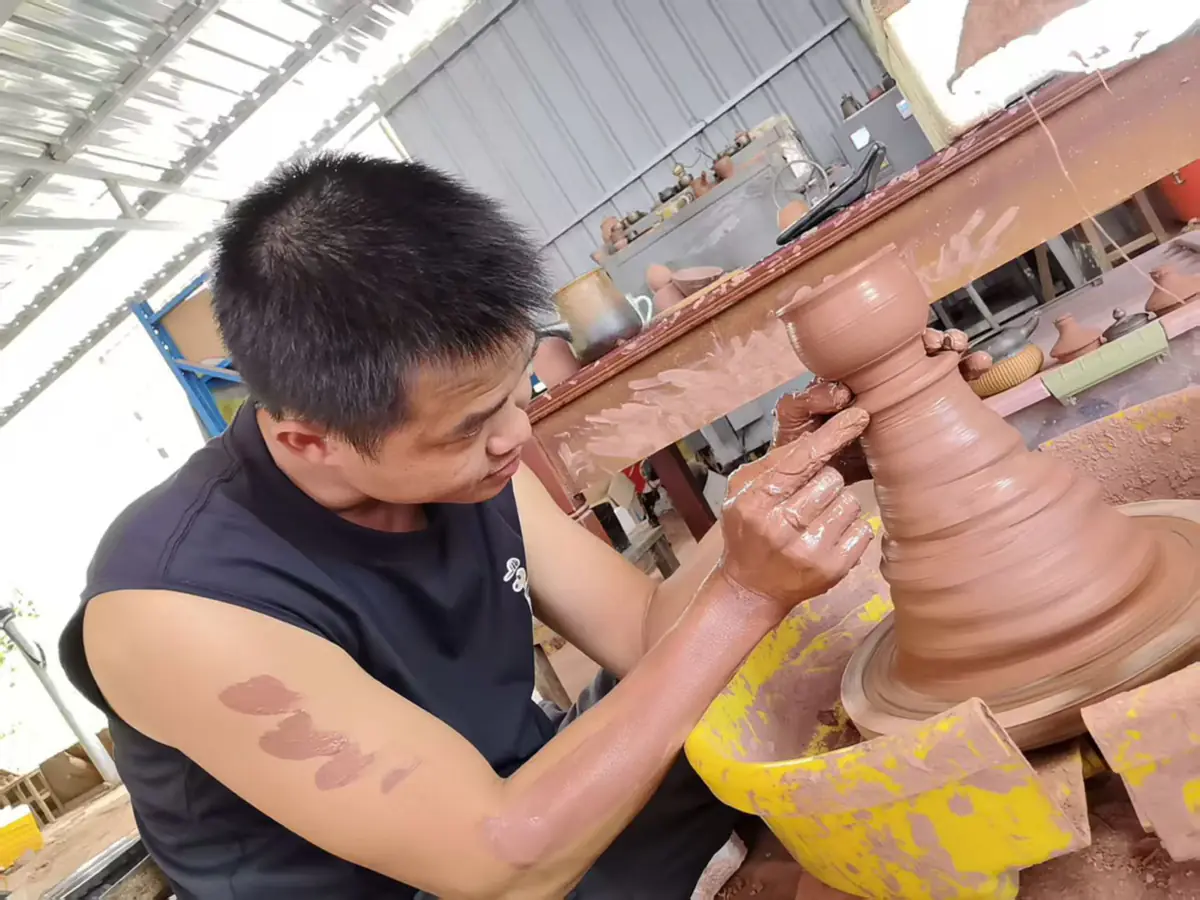
Li Huajin is a Nixing pottery maker from Qinzhou, Guangxi, China.
He has worked with Nixing pottery since 2012 and spent more than a decade learning teapot making with traditional craft master Lai Jun. That long period of practice gave him a solid grounding in clay, form, and the practical demands of a working teapot.
A Maker Led by Observation and Ideas
Li does not work from a fixed line of repeatable designs. Instead, each piece often begins with a particular image, texture, or idea. A tree-bark surface, a crab on a lid, the shape of a leaf, a stone, or a familiar traditional form may become the starting point for a new teapot.
This way of working gives his pieces a wide range of character and keeps each one distinct. Rather than reproducing the same model, he responds to the possibilities of the clay and develops each form individually.
Wood-Fired, One by One
Every teapot from Li Huajin’s workshop is wood-fired. In a wood kiln, flame, ash, heat, and airflow do not affect every piece in the same way. The firing gives each teapot its own surface, with variations in colour, texture, sheen, and kiln marks that cannot be reproduced exactly.
The individuality of the form is therefore matched by the individuality of the firing. Even when two pieces share a similar idea, their final surfaces will differ because of their position in the kiln and the natural movement of flame and wood ash.
Made for Tea, Not Only Display
Alongside its visual character, each teapot is made with everyday use in mind. Li pays close attention to the proportion of the body, the fit of the lid, the shape of the spout, and the balance of the handle.
His work is imaginative, but it is also intended to be held, used, and enjoyed over many tea sessions. Each finished piece reflects both the maker’s hand and the unpredictability of unglazed pine wood firing. No two are exactly alike.
Leave a Reply